65 Corn Hill Road,
P.O. Box 249
Brownfield, Maine 04010
(207) 935-3720
Contact Us!
Home
Workshops
Natural Building Wks
Timber Framing Wks
WK Registration
Web Store
FM School Campus
News & Info
Links
Contact US

A Timber Framer's Workshop
Joinery, Design & Construction of Traditional Timber Frames
by Steve Chappell.
"Throughout the book, Chappell shares an infectious love of the art and craft of timber framing. A
journeyman carpenter would be able to cut a timber frame with the information presented in this
book...His comprehensive 'Joinery Design', 'Tension Joinery', and 'Roof Framing & Truss Design'
sections are technical enough to hand to your engineer, but also comprehendable by the layman."
--Fine Homebuilding Magazine
This 250 page workbook includes comprehensive in-depth technical information on the joinery, design and construction of Traditional Timber Frames. Illustrated with over 230 photos and CAD drawings. Included are Frame Plans, design and engineering formulae, rule-of-thumb design and engineering guidelines, shop setup, builder's math, joinery design criteria, practical timber framing tips, tools and more. If you are an architect, engineer, builder or an aspiring owner builder wishing to build your own timber frame, A Timber Framer's Workshop will provide the information you need.
ISBN 1-889269-00-X $30 cover price.
Order on line Now
Fox Maple School of Traditional Building
Timber Framing Workshop
San Luis, Costa Rica
February 24-March 5, 2010


This workshop is part of Fox Maple's
Indigenous Peoples Community Building InitiativeFox Maple School of Traditional Building began developing its training program with indigenous peoples on the Pine Ridge Indian Reservation in the Fall of 2000. In the interim, the program has expanded to include projects in the mountains of Costa Rica and Kauai, Hawaii. Future projects in Ecuador and Nicaragua are currently under study.
The principal goal of the Indigenous Peoples Community Building Initiative (IPCBI), is to develop a sustainable building infrastructure within indigenous communities utilizing local natural materials and traditional systems and methods of construction. Initially, we go into a community and analyze the natural resource base, traditional building patterns, traditional cultural life-style, current life patterns and economic conditions. Through this we are able to develop a training program that uniquely embraces the communities environmental, cultural and architectural identity.
After completing a thorough survey, we then organize a formal workshop in which a community building is built for and with the people in the community. This includes active participation of from 8 to 12 community members (though a much greater number take part in the process), coupled with 8 to 10 students from outside the community. Primary funding for the building project is generated directly through the tuition paid by outside students. There is no cost to the local community. A unique, multi-cultural educational exchange results, training people in not only the craft of timber framing, but also a variety of natural and traditional building approaches that readily uses their local resources. In the process a needed structure that embraces the local cultural elements evolves. Through this interaction, a viable alternative building model seems naturally to develop that can then be expanded within the greater community. Success breeds success.
Garden at Finca la Bella cultivates endangered tree species.
Costa Rica Workshop Projects
The first two IPCBI workshop projects in Costa Rica took place in the winter of 2001. In that year we worked with the cooperative farming community of Finca la Bella to construct a community meeting hall. As a follow up, we constructed a park pavilion in the Children’s Park in Playa Tamarindo. Workshops also took place in 2002 and 2003 in which we built a bogega for the Monteverde Institute (which is now serving as a class room) in 2002, and an octagonal observation pavillion in 2003 at a biological research facility in Los Llanos.
Originally the pavilion was to be constructed for the Coope de Santa Elena, but financial difficulties threated to foreclose on the property. The coope has rebounded due in part to their association with Comercio Justo (Fair Trade), an international partnership of small farming communities who have bonded together to increase market share at fair prices in the face of the Free Trade Agreements devastating effect on small coffee producers throughout central and south America. By purchasing Fair Trade coffee, you will be directly benefiting the community of finca la bella, and all CSE coop members.
2004 project at el benificio in Lower San Luis, Costa Rica We returned in February 2004 to work again with the Coope de Santa Elena and Finca la Bella (a CSE cooperative community farm) in the construction of an octagonal pavilion at the coffee processing facility, el benificio, in lower San Luis. This is the location where the coffee beans are sun dried, dehusked using a water powered mill reminisant of a Rube Goldberg contraption, and roasted. The pavilion will be used as an information center where visitors can taste the coffee and learn about local coffee cultivation and processing, in hopes of increasing local retail sales.
Our efforts in Costa Rica have been very successful, with the fulfillment of our original vision of creating employment opportunities all but realized.
IPCBI’s efforts on all three fronts have been extremely successful and rewarding on many levels. To the students from outside the community who participate, it offers a great opportunity to learn timber framing and to share in a rich cultural exchange and experience.
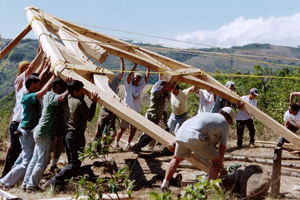
Raising first bent of octagon in the 2003 workshop.
2010 Workshop
Our work with the rural mountain community of San Luis, is ongoing. As in all of our IPCBI workshops, this is a great opportunity to learn the finer aspects of timber framing while at the same time integrating intimately into a very special community. In the 10 years that have passed since our first workshop in San Luis, we have cultivated an ideal location and an expanding infrastructure with a shop to conduct our workshops. We are situated on a beautiful organic fruit & coffee finca right in the heart of San Luis, with a cascading mountain river rushing by. In the past 2 years we have managed to procure a portable sawmill, and now can produce fine timbers of beautiful hardwood, harvested from nearby plantation grown trees. In this Introductory Workshop we cover all of the finer details of timber framing just as at our school site in Maine, but also go beyond to include scribe fitting timbers to stone, and working with natural curved round logs, scribe fit, square to round, round to square, in the vernacular Japanese tradition. The only other difference is that the temperature in Maine in February hovers around 0 degrees, while in San Luis, it is in the mid 80's. So where do you want to be the last week of February and the first week of March this year?
Home stay lodging with local families, including all meals, is included in this workshop.The Winter 2010 course is an Intro Timber Framing workshop and will include a mix of both western and eastern joinery systems. This will include square rule and round log scribe timber frame joinery techniques. Students will also learn how to scribe timber to stone. Though the environment is different and the designs are adapted to meet the unique environmental needs of the north central mountains of Costa Rica, the course instruction is equal to that of all of our workshops, including those at the Fox Maple campus in Maine.
What's Included
Homestay lodging with local families and all meals are included. In the past we have attempted to coordinate transportation from San Jose to the site, but the logistics never seem to work out due to the broad range of arrival dates. Regular bus service is available from San Jose. Complete information about this and all logistical details will be sent out upon registration.Travel to Costa Rica
Flights should be booked to San Jose, or Liberia, Costa Rica. Monteverde/Santa Elena is approximately 4 hours drive from San Jose and 3 hours from Liberia. Bus service from San Jose to Monteverde/Santa Elena is available. Most major airlines fly to San Jose and Liberia with direct flights from several major US cities. Flights can also be booked to Liberia, Costa Rica which is in Guanacaste. This is a bit closer to San Luis (now that the roads have been repaired), and is a much smaller airport--making it easier to deal with customs, etc.If you have any questions or would like more information about this workshop, please send us an email Contact Us
Click here to see pics from the 2001 Costa Rica workshop.
Click here for additional Costa Rica workshop and background info.
Tuition $1,250. Limited to 12 students. Registration.
Click below to download IPCBI newsletter in pdf format
Indigenous Peoples Community Building Initiative Newsletter
El boletín de IPCBI está ahora disponible en el español. Para descargar, hacer clic abajo.
IPCBI boletin en Espanol